Sunday, October 21, 2007

A Bellvale Mountain Ghost Story

Here is a recently discovered story, from the Warwick Advertiser, January 17, 1889:
A Mysterious Treasure Bed
Treasure Seekers at Greenwood Lake Succumb to Fright when the Wealth is almost at Hand—
A Tale of Local Mystery

To persons of imaginative minds and skeptical tendencies the mysterious tales of treasure hunters and the difficulties encountered on their ghostly expeditions are utterly unworthy of belief, and the creations of a weak mind. In fact, in this age of materialism, we are prone to look with pity and contempt on persons who prate of a belief in the mysterious, and point with triumph to the success of the Thirteen Club of New York in dispelling some of our fondest illusions and iconoclastically eradicating even our familiar household sayings, handed down from mother to daughter. The dropping of a fork meant in my boyhood a male visitor to the house; a fallen knife denoted a female. There were many other signs and tokens, but to break a mirror signified dire calamity. Filled with these impressions when young it is a continual combat with many to explain on a purely reasonable basis the many mysterious occurrences brought up by believers in the supernatural in support of their belief, and many a time have most of us wished fo an opportunity to destroy, at one fell swoop, the hydra-headed demon, superstition, and settle the questions so far as we, individually were concerned.

A few nights since we were regaled with stories of revolutionary times in the Warwick Valley. The settlers were, of course, arrayed on both sides, and some maintained an appearance of neutrality but were really helping the Continentals or Tories to the full extent of their means and ability. There were some, too, who secretly gave information to headquarters, acting as spies, so that the commanding officers of both armies were ekpt pretty well supplied with all the information they needed. In this valley the site of a house long since gone to decay, which was occupied by a Mr. Smith, is pointed out to the lover of the historical, and he is told how said Smith was watched by his loyal neighbors, tracked through miles of forests, over mountains and across swamps, till, the evidence being sufficiently clear, was taken from his bed at the dead of night by a mob of disguised men, and on being threatened with death, confessed all his perfidy to the patriot cause. His captors decided to send him within British lines, and ordered Smith back to his house to dress himself, for he had been shivering in the damp air in his night clothes. As he turned to enter his house he was shot in the back by some of the mob and died without a groan.

While scouting parties in the Revolutionary days were despoiling house after house under the cover of darkness, the people found it necessary to secrete money and valuables in the most inaccessible places, often in the rocks, down the wells, up the chimneys, etc. Valuable articles and money are recovered year after year and much is undoubtedly still hidden. Many years since an old man came to Greenwood Lake and told a table of treasures hidden at a certain triangular place near the foot of Mount Peter, near the ruins of the house where the aforesaid Smith resided, and from a rude diagram located the spot on Mr. John Hunt’s farm. All the necessary identification marks were there except a certain chestnut tree with a plug in the trunk pointing to the spot. But the stump of a chestnut tree being close by the place located by the ancient stranger seemed to give evidence sufficient to warrant a digging party to attempt the recovery of the treasure. In order to keep the affair secret they agreed to go at nightfall to the spot, and at the time set a half dozen sturdy men assembled.

They had not dug long before their picks struck a huge rock, and while endeavoring to remove it the whole party distinctly heard groans and cries, the clanking of chains and a rumbling as of an impending thunder shower. At firs they were dumbfounded and stopped their work. As they ceased the noise died away. Gathering courage after a short rest they renewed their efforts to dislodge the huge stone. Again the noises, apparently proceeding from under the boulder at one time and then from the air overhead, were heard, and, with one impulse, they dropped their picks, shovels, and crowbars and rushed homeward as on the wings of the wind.

The story of the mysterious occurrences, magnified, of course, by each relator, soon became the popular gossip, but the earnestness and sincerity of the digging party was never questioned, and for years the treasure lay undisturbed, although occasionally in the last thirty or forty years small parties have gathered to dig a little deeper than the preceding party had done, and then when the unearthly sounds grew too weird for mortal ears, rush away pell mell, well provided with a never-ending theme for speculation in their night’s adventures.

Well, during the summer of ’88 (1888) the foregoing was narrated, with numerous embellishments and interspersed with many ejaculations to a few hardy and intelligent young men who were temporarily sojourning with Hon. James Hall at Greenwood Lake. After due consideration a party was formed in no spirit of bravado, with an honest intention of unearthing the mystery surrounding the buried treasure (if treasure and mystery, there were), resolved to go the next night to the spot indicated. The place was not readily found in the inky darkness, and the party fought with the thorns and brambles step by step till, well nigh out of patience, the site of the curried treasure was reached.

The party was then divided. One was to keep watch, one attend the fire to give light to the workers, and two plied the pick and shovel. The accumulated leaves and debris of a score of years was soon dug from the hold, and the excavation proceeded without interruption until a huge rock was laid bare. With crowbars the two study men endeavored to dislodge the rock when suddenly a long drawn and unearthly groan was heard, apparently proceeding from under the earth a short distance away. The men paused in their work, the sentinel went to the spot from whence groans came and the groans died away. After a few moments the party became convinced that as they had seen nothing to frighten them they wouldn’t be frightened, so they built a roaring, crackling fire, and by the light of its flickering flames resumed their work. So long as they were quite no noises were heard, but as soon as the digging was resumed the moans and groans were awful. Flashes of sulpherous light were seen, jumping from bush to bush, stones fell in showers all around them, and the guard, albeit a man of iron nerve, chased the sounds with pistol bullets, only to be rewarded after each shot with a mocking peal of hoarse laughter.

Then again midnight stillness ensued as the entire quartet left their work and formed a searching party. Not a sound of life could be heard save the “nancy-dids,” and after ten minutes’ conference they loaded their pistols and resolved to remove the bowlder from the excavation. Soon as the work began the noises were resumed, only more so. It seems as though a dozen demons had united their energies in clanking chains, flashing lights in the half circle round the working party and groaning in a hoarse, moaning, droning manner, like the wail of a lost soul, or the yowling and crying of some of our well-bred city cats practicing for a concert in a back yard. But, of course, cats can’t throw huge bowlders, rattle chains and produce noises which language fairs to describe. The moans ceased when the workmen halted and began as soon as they resumed.

Finally, the stones and dirt thrown out of the hole began to roll back into it again, and the shovelers saw their work was being undone faster than they could dig and delve. The guard, meanwhile, had formed a cordon, with two loaded revolvers, round the party and pursued the noises from spot to spot, till, thoroughly mystified, and finding their work useless, they resolved to retire in good order and leave the treasure in possession of the owner or owners of the cries, groans, moans, chains and flash lights. Now, if anybody of men of venturesome turn of mind, able to handl pick and shovel, and with a desire to participate in the mysterious, wishes to go through our experience while digging for treasure on Mr. Hunt’s premises, they have our heariest wishes for their ultimate success. So far as we are concerned it would have to be a much greater sum of money than tradition has recorded to attempt it again.

Monday, September 10, 2007

Lenape Connections

The tribe that populated the Warwick area at the time of European colonization were the Minsi, or Munsee, northernmost branch of the Lenapes. Two of the main villages in our town were Mistucky, (eastern side of Rt. 94 and according to early maps, slightly south of the Welling homestead, somewhat towards the mountain) and Quampium, which was at the northern end of Greenwood Lake (now flooded, as the lake was enlarged). There are oral traditions of other sites and exhanges between the colonists and the natives.

Recently we had occasion to try to hunt up the home of the original Wawayanda Indian Deed, given March 5, 1702/3, in order to get the signature of the local chief, Chuckhass. On a microfilm reel at the Goshen Public Library is what appears to be a contemporary copy of the deed, with what appears to be the traced signatures (possibly original). Subsequently the Tate Collection yielded a photocopy of what must be the original document, but alas no note was made of its location-- the signature for Chuckhass is a near match:

In this (copy) document the name appears to be spelled "Cheeckhass", but on the photocopy from the Tate collection, it appears more like the traditional rendering via oral tradition, "Chuckhass". Likely the name's sound was in between, and so rendered differently.

The entire deed can be seen at:
http://www.albertwisnerlibrary.org/~wisner/Factsandhistory/History/Curriculum%20Powerpoint/WawayandaPatentIndianDeed.jpg


On Sept. 23 there will be a great celebration of the opening of the Black Creek historic site in Vernon which has become one of the most significant Lenape heritage site. It is off Maple Grange Rd.. A wonderful website has been done by the Vernon Historical Society:

http://www.vernonhistoricalsociety.com/Black%20Creek%20Site.html

It will be a rare chance for guided tours and nearby celebrations by the Nanticoke Lenape tribe.

Saturday, July 21, 2007

Warwick Hosts Big Wigs & Rowdy Soldiers

During the Revolutionary era, Warwick really was on the main road; travellers, troops, officials, and mail that needed to skirt safely by British-held New York City trotted, trundled, plodded, and marched through with regularity. This included George Washington (who stopped...everywhere, apparently), and other troops and officials. Much has been made of Gen. Washington's visit(s) here, and one explanation of his frequently finding Warwick a convenient place to stop is that a member of his Life Guard, Uzal Knapp, had a brother here.

Next week the Historical Society will hold its annual Washington Day Picnic. In honor of that event, we offer these tales of soldiers & travellers, gleaned from the Notebook of W.B. Sayer, recently donated as part of the Florence Tate Collection:

May 20, 1779 Third New Hampshire Regiment under Col Henry Dearborn stopped here for breakfast (This regiment saved the day in the battle with the Indians near Elmira NY under Gen Sullivan.)

Oct. 20 1779 After the Battle at Elmira NY Capt. Phillip Du Bois Beiver? Bevier? & Lieut. Frees of the 3rd Regiment Continental Line under Col. Van Courtland stayed all night here.
Rev. James Manning a Baptist Minister from Providence, RI took dinner here Sept. 12, 1779 with Francis Baird.

In 1777 Col. Daniel Morgan’s men after the Battle of Saratoga NY stopped here (note: documentation not yet confirmed)

The journal of Captain Daniel Livermore says Thursday May 20, 1779:
“This morning the weather still continued rainy necessity obliged us to continue the march, the traveling is extremely bad, and 9 o’clock made a halt at a small village called Warwick, NY, six miles. Here we took breakfast at Baird’s Tavern, from whence we proceeded on the march to Hardiston, NJ 7 miles .”These troops were on the march to join Gen. Sullivan’s expedition against the Indians.

Diary of Ensign Daniel Gorkin2nd New Hampshire Regiment of Gen. Sullivan’s Expedition 1779.May 20, 1779—To Warwick NY from Chester NY 14 miles.May 21-Rainy day did not march. This place Warwick NY is 4 miles from the New Jersey line.May 22- Did not march.May 23—To Sussex Court House NJ, here are 4 or 5 very good houses.The houses from the North River (at Newburgh NY to this place) are small having large crops of wheat and rye. The men do but little work. The women great shots, marched 22 miles. (The 2d New Hampshire Regiment spent 3 nights and 2 days at Warwick NY—WBS?)

Capt. Daniel Livermore says on Saturday Oct. 3, 1779: The troops leave Sussex NJ at 9 o’clock and march toward Warwick NY about 14 miles and camp. Sunday Oct. 3, 1779 today the troops proceed on the march and encamp near Warwick Church (now 1927 corner of Galloway & Forester Aves. On land that 1927 belongs to Clarence Forshee). Monday Nov. 1, 1779 this day for want of wagons the march is deferred until 12 o’clock. Proceed over the mountains to Pompton. Roads very bad…


Diary of Ensign Daniel Gorkin
2nd New Hampshire Regiment of Gen. Sullivan’s Expedition 1779.
May 20, 1779—To Warwick NY from Chester NY 14 miles.
May 21-Rainy day did not march. This place Warwick NY is 4 miles from the New Jersey line.
May 22- Did not march.
May 23—To Sussex Court House NJ, here are 4 or 5 very good houses.
The houses from the North River (at Newburgh NY to this place) are small having large crops of wheat and rye. The men do but little work. The women great shots, marched 22 miles.
(The 2d New Hampshire Regiment spent 3 nights and 2 days at Warwick NY)

Journal of Major Grant
Journal of Sergant Major George Grand of the 3rd New Jersey Regiment Sullivan’s Expedition of 1779. He writes as follows of the return of the expedition:
Oct. 30, 1779. To Sussex Court House NJ.
Oct 31 To Wallins Tavern
Nov. 1 To Warwick NY.
Nov. 2 Parted with the Western Army
Nov. 3 Marched to Sterling Works.
From this journal it seems the whole Western army was at Warwick NY on Nov. 1, 1779. Oct 17,1779 it was at Easton PA and Gen. George Washington visited it. Oct. 27, 1779 it crossed the Delaware River at Easton, PA.

Gen. Washington passed thro Warwick NY in 1779—The Sussex Independent of Nov. 15, 1912, gives an account of the placing of a boulder on the field near Hamburgh, NJ upon which Gen. George Washington’s troops camped for a night curing their march from Newburg NY to Morristown NJ in the year 1779. John Kays was with Gen. Washington and he stated that they came by way of Warwick NY and Vernon NJ, crossed the Mts. At Sparta, thence to Morristown NJ where they joined G.en Lafayette.

In the fall of 1780 Lady Martha Washington stayed all night here on her way from Newburgh, NY to Mount Vernon (note: documentation not yet confirmed)


July 17, 1782 Gen. George Washington and his two aides Col. Jonathan Trumbull, Jr. and Major Benjamin Walker stopped here and bought 2 shillings worth of grog.

Dec. 6, 1782 Marquis de Chastellux stayed here all night with his aides and said of Warwick:
From his “Travels in North America in the years 1780-82”. The Marquis De Chastellux was one of the 40 members of the French Academy and Major General in the French army service under Count Rochambeau.
Vol. 2, p. 302 (Dec. 6, 1782?) Traveling from West Point NY to Philadelphia Penn. Via Easton he says:
“I still kept skirting this ridge of mountains which separate this country from the Clove—
Warwick NY where I slept a pretty large place for so wild a country, is 12 miles from Chester NY and 28 miles from Newburgh NY. I lodged here in a very good stone inn, kepty by Mr. Smith, the same whose house I had slept 2 years before at Cheat, which was much interior to this (Baird’s Tavern—Sue G.). The American Army having for 2 years past had their winter quarters near West Point NY, Mr. Smith imagined with reason that this road would be more frequented than that of Paramus and he had taken the inn of Mr. Francis Baird at whose house we stopped next day for breakfast. The house had been given up to him with some furniture and he had upwards of 150 acres of land belonging to it, for the whole of which he paid Seventy pounds currency making 100 pistoles. I had every reason to be content with my old acquaintances and the new establishment.
The next morning Dec. 7, 1782 we set out before breakfast and the snow began to fall as soon as we got on horse back which did not cease till we got to Baird’s Tavern. This house was not near so good as the other, but the workmen were busy augmenting it. On enquiring of Mr. Francis Baird, who is a Scotchman (note by Tate: De Chastellux said “Irishman”; WBS said Scotsman was correct.—“Cheat” = Kakiat. Kaceat?), the reason of his quoting his good house at Warwick NY to keep this inn, he informed me that it was a settlement he was forming for his son-in-law and that as son as he had put it in order he should return to his house in Warwick NY. This Mr. Francis Baird had long lived as a merchant at New York City and even sold books, which I learnt from observing some good ones at his house, amongst others “Human Prudence”, which I purchased of him. It ceased snowing at noon and the weather moderated.”

Stories Told Over the Years

After passing through Warwick just east of what is now 1927 Forester apartments (Wawayanda House, nearly opposite intersection of Forester Ave. with Colonial Ave.—Sue G.) near where Ms. Thomas Nesbit now 1927 lives, Gen. George Washington passed an old negro who raised his hat and bowed very low, Gen. Washington returned the salute and when asked by his aides why he did so said he "would not be outdone in courtesy by an old negro slave."

During the Revolutionary War while New York City was in possession of the British communication between the Hudson & Delaware Rivers was kept thro Warwick.While Gen. George Washington with his army was lying a new Windsor in 1780, as was his custom at the close of a campaign he send his aid-de-Camp to Mount Vernon VA to escort Lady Washington to the camp. She usually traveled in a plain chariot, accompanied by postillions in White and Scarlet liveries. On her return to Mt. Vernon she passed thro Warwick Ny stopping over night in the fall of 1780 at the tavern. David Christie, then a boy living some 2 miles north of Warwick NY and who afterwards represented us in the Legislature, in after years told the story how he came to the village to get a plow share mended and learning that Lady Washington was about to proceed on her journey, stationed himself in the bushes on the bank of Longhouse Creek near where the First National Bank building stands and saw the grand equipage as it passed bearing the good Martha Washington toward Mt. Vernon.

Saturday, June 23, 2007

Payday for Hathorn


John Hathorn was Warwick's leader of the militia during the Revolutionary War, and his home still stands on Hathorn Rd; information about him is available in several sources, yet he remains a sketchy figure because his personal papers were destroyed by the family sometime after his death.

However, he was a literate man and in his roles as community leader, and a New York and U.S. Congressman, he would have written many letters and papers to others. These are slowly being sought out, and this week the Warwick Historical Society was fortunate to obtain one of these manuscripts -- his request for pay for attendance at the New York Legislature in 1783, as the war was winding to a close.

The Society also owns a few of his books-- as Independance was declared and he took on his role as military leader, he purchased a British military manual, printed in 1776:


Other Hathorn manuscripts, including a scan of his report on the Battle of Minisink, and be seen on the Warwick Valley History website.

Friday, June 1, 2007

Home of Inventions

Recently I became aware that Google had made the old U. S. Patents database searcheable by keyword. One of the problems with searching for local patents is that you had to have a patent number for any of the older patents, in order to find it. I don't know how Google's going to sustain developing valuable information like this at a substantial cost and then giving it away for free, but for now, what a great tool: http://www.google.com/patents

I did a search for Warwick and her hamlets and villages, and came up with an amazing number of patents and downloaded them; one day I'll make an index to them, but in the meantime, here's a sampling:

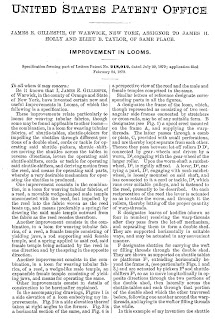
The "most inventingist" Warwickian was James Gillespie, the owner of the Fabric Fire Hose Company, with 16 patents related to fire hoses and equipment. Here's one of them (click on the image to go to the patent page)

There are lots of practical items like:

Shutter closers by W. W. VanDuzer, no. 697297
http://www.google.com/patents?id=jrVMAAAAEBAJ&dq=697297

Knife design by R. L. Shepard, no. 943174 http://www.google.com/patents?id=tgR-AAAAEBAJ&dq=969303

A wrench by J. L. Finch, no. 378299
http://www.google.com/patents?id=_fNZAAAAEBAJ&dq=378299


And lots, lots more! The more recent patents, after 1960, tend to be very high-tech, on behalf of major corporations like Georgia Pacific, International Paper, etc. Don't go crazy trying to find them all, unless you are having fun-- I can make a CD of them on for any Warwick researcher that would like it, just leave a message for me at the library.

Sunday, May 20, 2007

Archives Lost & Archives Found

Last Sunday the main house of Borderland Farm on Rt. 94 burned, with tragic results. This house was about 150 years old, and in addition to the terrible loss of a life, and a home, owner Virginia Martin has lost the archival records of her family & the historic homestead, which she had intended to share with the Historical Society. Our condolences to Virginia and the family; the community sorrows with you.

The same week we were notified that the Lehigh & Hudson River Railway Veteran's Association had gotten a call from Orange County Community College. They needed to clean out an old garage, and discovered 150 boxes of archives of Warwick's Lehigh & Hudson River Railway. Years ago when the railroad office closed, the valuable archive was transferred to OCCC. It was transfered eventually to the railway museum in Strasburg, PA-- or so it was thought. Apparently only some of the records were transferred, and everyone had forgotten this huge lot of records! Many people don't realize that without the L & HRR, and the commerce, jobs, and wealth it gave rise to, Warwick as we know it would not exist.
For more on the railroad, check out Marty Feldner's web site: http://lhr.railfan.net
Over the next week or so the railroad club will rescue the records and store them temporarily, with the finacial help of the Historical Society of the Town of Warwick and the Carriage House Storage owners, Jack and Janice Hubert. There they'll be sorted and an inventory created, so that a new, secure home that is accessible to researchers can be found.

Sunday, May 13, 2007

Troublesome Youth


A true sign of spring, when the weather warms up all of the teenagers climb up out of cyberspace and begin to wander around, dazed in the sunlight. This can be very annoying for those who are not teenagers any more: loud music, rude observations, and just generally disrupting anything they feel like. In days gone by, some of the worst youth offenders from New York ended up here in Warwick, at the NYS Training School for Boys-- a reform school, now the site of the Mid-Orange Correctional Facility. One of the success stories to come out of the school is that of Conrad E. Mauge' Jr., or "Frenchy" as he was nicknamed then. A few years back we helped a professor from Boston University figure out who the pseudonymous "Frenchy" really was. I've copied the article I did then below, and this photo shows him in 1951.
“Frenchy” is Found

Thanks to the teamwork of several local residents and researchers, the search for “Frenchy” of WVHS in 1950 has been successful. Boston College professor Carlo Rotella was trying to find him for a project involving the book that was written about the boy, “Out of the Burning” by Ira H. Freeman, published in 1960. A pseudonym had been used, and all trace of Frenchy’s real identity had disappeared when Ira Freeman died. Frenchy’s real name was Conrad E. Mauge′, Jr.

Joanne Cheney, librarian at Warwick High School, was able to find his name. It was also verified by several local residents who remembered him. From there his life was traced by the Local History Dept. of Albert Wisner Library.

Conrad arrived at the New York State Training School for Boys here in Warwick in 1949, after a long and hard road as leader of a Brooklyn gang before he was 14.
His arrival at Warwick brought him into a completely alien environment. He had never been in the country, and recalls that he had never had an intelligent conversation until he talked with the State School librarian one day.
Having an I.Q. of 160 and with good behavior at the school, he was sent in a test program to the regular High School with another boy, William Barron. At the public High School he was initially shunned. He says there were only two other African Americans at Warwick High at that time, and even they wouldn’t talk to him because he was from the State School. After a few weeks however, a “Polish girl with an unpronounceable name” invited him to listen to records with her friends. We don’t know who she was, but her invitation was important to his adjustment to a new life and his acceptance at the school.
He excelled in Track, which was his ticket to higher education. From there he went on to finish high school in Brooklyn at the age of 16, and attended Brooklyn College and St. John’s University. He eventually achieved a Ph D.

He ran a recovery center for AIDS and substance abuse victims on his home turf of Bedford Stuyvesant in the 1980’s, and later turned to the study of African religions, publishing several books and articles. One of his hobbies was Calypso music, part of his parents’ heritage from their native Trinidad. His song “Zombie Jamboree” was recorded by the Kingston Trio. He passed away in 1998.

The book "Out of the Burning" is written in first person from extensive interviews with Conrad, and is such a gripping tale of life in Bedford Stuyvesant in the 1940’s and Conrad’s complete change of direction that it reads like a fast paced thriller. The last quarter of the book takes place in Warwick, with vivid descriptions of what daily life was like for the boys at the reform school, and local names popping up from time to time. The Albert Wisner Library has a copy of the book available for checkout--but don’t skip ahead to the Warwick part, or you will miss the true impact of his successes.